Readings:
Genesis 12 and 13
Matthew 5
Genesis:
Covenant was introduced in the Noah story, but this is the beginning of the Abrahamic covenant. Buckle your seatbelts for the rest of this Genesis ride, folks! Abram is sent by God to a new land. He will be a blessing. Abram is prototypical in this story, as are most characters in Genesis. This means that these characters stand for more than just themselves. The story of Abram is the story of the people of Israel. Throughout the rest of this narrative, listen for words of blessing, for providence, for promises being made and kept, and for God's faithfulness in the midst of human's humanness.
12:10 the NRSV translates a Hebrew word as "reside there as an alien". The other translation is "sojourner". Much of the story of Israel is of being "sojourners" or "strangers in a strange land". How does that, even today, shape the experience of the nation Israel?
Matthew:
This begins the Sermon on the Mount. There is actually a mount. It is very near Capernaum on the north shore of the Sea of Galilee.
Some translations differ from the NRSV on the word "blessed are..." in the beatitudes. The word could also mean "happy are..."
Notice the similarities and the differences between Matthew and Luke's account of the Sermon on the Mount. Matthew's account is much longer, to start with.
But there is very much a sense of radical realignment of how things are supposed to be. "Happy are you who mourn." Really? How?
I would argue that all people who advocate non-violence are influenced by Jesus' message here, because Jesus is forcing people to see the world differently. Where the world says "might makes right", Jesus says, "blessed are the peacemakers."
For example, look at 5:41--"and if anyone forces you to go one mile, go also the second mile". It was practice for Roman soldiers to ask people to carry their baggage for them. But they could only ask you to carry it for one mile. So, if you voluntarily carry it the second mile, the Roman soldier would actually be in the position of begging you to stop carrying their luggage. In a culture of honor and shame, you would have much more honor from carrying something the second mile than you would in resisting to carry it in the first place.
Showing posts with label Covenant. Show all posts
Showing posts with label Covenant. Show all posts

June 5, 2009
Readings:
Genesis 9-11
Matthew 4
Covenant is sort of a big deal in Genesis. "Covenant" means a contract, a relationship between God and humanity. We are not equal partners in the contract, however. We're only in it by God's grace. We never earn our share of the covenant.
You normally think of Abraham when you think of God establishing the covenant, but first it is established with Noah.
And the first thing Noah does after the covenant?--He goes out and drinks too much wine. Alas.
We then have the "table of the nations", where it is explained how all of the different countries were created. This leads in to the Tower of Babel.
I love this story.
On one hand it seems strange to us. Wouldn't God want people to "speak the same language" (whether literally or metaphorically) and work together?
But, when people all speak the same language, they don't work to solve the world's problems, they build a monument to themselves.
So God scatters and confuses their words.
Consider that multiple languages and cultures are God's intention. How does that change the way we view the "other"?
Matthew 4
Temptation of Jesus in the wilderness--note that Satan (which is Hebrew for "the accuser") tempts Jesus, and it is about the appropriate use of power, and about authority. It also shows that knowledge of Scripture helps Jesus through the temptation.
Then John the Baptizer is arrested and Jesus starts proclaiming what John had already proclaimed, "repent, for the kingdom of heaven has come near". "Kingdom of Heaven" is Matthew's term for "Kingdom of God" that is used in other gospels.
Jesus, at this point, moves away from both the wilderness and the big city of Jerusalem and heads to Capernaum, a sleepy fishing village on the NW coast of the Sea of Galilee.
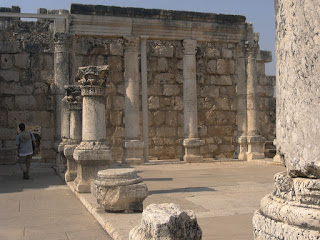 The ruins of the synagogue in Capernaum.
 The Sea of Galilee near Capernaum.
It is at this point in Matthew's Gospel that Jesus calls his disciples. Imagine being a fisherman in a backwoods town, when Jesus shows up and calls you to fish for people.
Would Christianity have been different if Jesus had called his disciples from Jerusalem or New York City or Tokyo?
Genesis 9-11
Matthew 4
Covenant is sort of a big deal in Genesis. "Covenant" means a contract, a relationship between God and humanity. We are not equal partners in the contract, however. We're only in it by God's grace. We never earn our share of the covenant.
You normally think of Abraham when you think of God establishing the covenant, but first it is established with Noah.
And the first thing Noah does after the covenant?--He goes out and drinks too much wine. Alas.
We then have the "table of the nations", where it is explained how all of the different countries were created. This leads in to the Tower of Babel.
I love this story.
On one hand it seems strange to us. Wouldn't God want people to "speak the same language" (whether literally or metaphorically) and work together?
But, when people all speak the same language, they don't work to solve the world's problems, they build a monument to themselves.
So God scatters and confuses their words.
Consider that multiple languages and cultures are God's intention. How does that change the way we view the "other"?
Matthew 4
Temptation of Jesus in the wilderness--note that Satan (which is Hebrew for "the accuser") tempts Jesus, and it is about the appropriate use of power, and about authority. It also shows that knowledge of Scripture helps Jesus through the temptation.
Then John the Baptizer is arrested and Jesus starts proclaiming what John had already proclaimed, "repent, for the kingdom of heaven has come near". "Kingdom of Heaven" is Matthew's term for "Kingdom of God" that is used in other gospels.
Jesus, at this point, moves away from both the wilderness and the big city of Jerusalem and heads to Capernaum, a sleepy fishing village on the NW coast of the Sea of Galilee.
 The ruins of the synagogue in Capernaum.
 The Sea of Galilee near Capernaum.
It is at this point in Matthew's Gospel that Jesus calls his disciples. Imagine being a fisherman in a backwoods town, when Jesus shows up and calls you to fish for people.
Would Christianity have been different if Jesus had called his disciples from Jerusalem or New York City or Tokyo?
Subscribe to:
Posts (Atom)

